

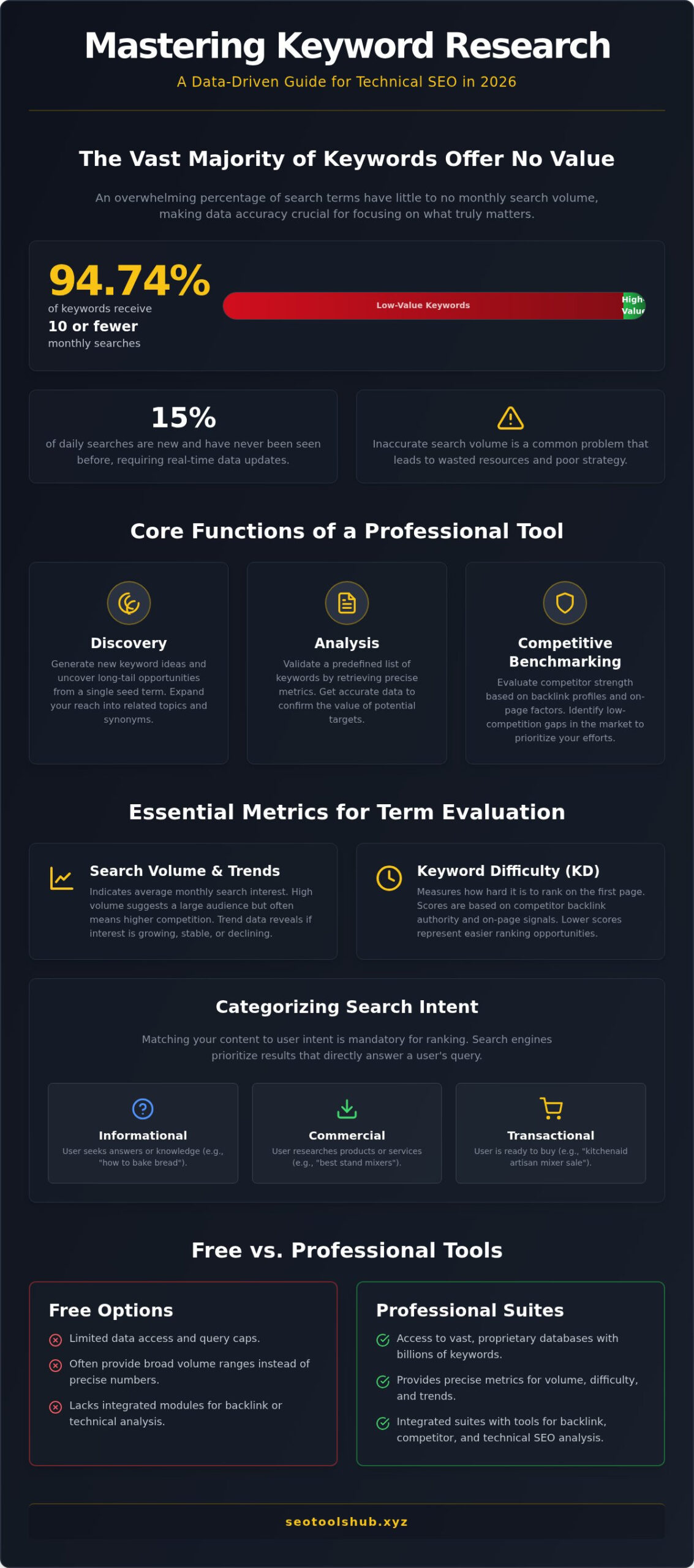
94.74% of keywords receive 10 or fewer monthly searches. Most search terms provide no traffic value. Professional users often face information overload from complex software. Inaccurate search volume data is a common problem. You don’t want to pay high subscription costs for unused features. A functional keyword research tool must provide precise metrics. Data accuracy is essential for search visibility. Reliable data helps you make better decisions.
This article is a technical guide to search term data. It focuses on functional evaluation for 2026. You’ll learn to identify high-value search terms. We explain competitive difficulty. This guide streamlines content planning workflows. The focus remains on technical utility. You can avoid unnecessary complexity. Efficient tools help you manage search visibility. We prioritize clarity over decorative features. This approach saves time. It allows for a methodical planning process. You’ll gain a clear path to search success.
Key Takeaways
- Understand the data retrieval process for search APIs. This knowledge ensures technical accuracy.
- Evaluate search volume and keyword difficulty metrics. These values indicate potential visibility.
- Compare free options with a professional keyword research tool. Integrated suites provide data for complex tasks.
- Implement a systematic workflow for term discovery. Use seed terms to generate relevant variations.
- Utilize integrated modules for backlink and technical analysis. This approach improves planning efficiency.
Understanding Keyword Research Tool Functions
A keyword research tool identifies terms users enter into search engines. This software serves as a technical bridge. It allows marketers to see exactly what people type. This process is the foundation of keyword research. The tool simplifies complex data sets. It turns raw logs into actionable insights. Every search represents a specific user intent. The software helps categorize these intents. It provides a structured way to view the market. Marketers don’t have to rely on intuition.
The software retrieves data from search engine APIs. It also uses proprietary databases. These systems store billions of data points. A keyword research tool processes this information in seconds. It provides quantitative metrics for evaluation. These metrics include search volume. They also include keyword difficulty. Users see how many people search for a phrase. They see how hard it is to rank. This data is essential for search visibility management. It removes guesswork from the planning process.
94.74% of keywords get 10 or fewer monthly searches. This statistic highlights the need for accuracy. A keyword research tool filters out these low-value terms. It focuses on the remaining high-value opportunities. This focus saves resources. 15% of daily searches are new. Tools must update their databases frequently. This ensures they capture emerging trends. SEO Tools Hub provides these updates in real time. The platform maintains a focus on technical utility.
Primary functions include three main areas. Discovery is the first area. Analysis is the second area. Competitive benchmarking is the third area. Each function serves a specific purpose. Discovery helps find new opportunities. Analysis validates those opportunities with data. Benchmarking compares your performance to others. These functions create a complete workflow. They help users build a data-driven strategy. The focus remains on functional results.
The Role of Search Engine Databases
Tools aggregate data from major platforms. They pull information from Google. They also pull data from Bing. These databases store historical search volume. They track seasonal trend information. This history is valuable for planning. It shows how interest changes over time. Some terms are popular in summer. Others peak in winter. The tool identifies these patterns. Real-time scraping provides current suggestions. This includes autocomplete data. It also includes related search suggestions. These features capture immediate changes in user behavior.
Discovery vs. Analysis Modules
Discovery modules generate new term ideas. A user enters a seed keyword. The tool provides a list of variations. It finds synonyms. It also finds related topics. This module expands the scope of research. It uncovers long-tail keywords. Analysis modules work differently. They provide specific metrics for a pre-defined list. Users upload their own keywords. The tool returns data for each one. This module validates the value of a list. Effective tools balance these two modules. They offer broad expansion through discovery. They provide narrow data validation through analysis. This balance ensures accuracy in content planning.
Essential Metrics for Search Term Evaluation
Evaluation requires specific data points. A keyword research tool provides these values. These metrics guide resource allocation. They help identify high-value terms. Users can avoid terms with no traffic potential. Precise evaluation improves search visibility. Reliable data is the basis for every content decision.
Interpreting Search Volume and Trends
Search volume indicates average monthly interest. It’s a numerical estimate of potential traffic. High volume suggests a large audience. It also correlates with higher competition. 15% of daily searches are new. This makes real-time data essential for accuracy. Monthly volume is an average. It fluctuates by season. Trend data shows interest growth or decline. Stable trends are better for long-term planning. Declining trends suggest a loss of market interest. Growing trends indicate emerging opportunities.
Analyzing Keyword Difficulty and Competition
Keyword difficulty measures competitor strength. Scores rely on backlink profiles. They also consider on-page optimization. Lower scores represent easier entry points. New content should target these gaps. Difficulty scores use competitor backlink data to evaluate the authority of ranking domains. Factors include title tags and header structure. A keyword research tool allows for precise difficulty filtering. This helps prioritize low-competition terms.
Categorizing Search Intent
Search intent classifies user purpose. Matching content to intent is mandatory. Search engines favor content providing a direct match to the user’s original intent. Misalignment leads to high bounce rates. There are three primary categories:
- Informational intent: Users seek answers or general knowledge.
- Commercial intent: Users research products or services before buying.
- Transactional intent: Users are ready to make a specific purchase.
Cost Per Click (CPC) reflects commercial value. High CPC indicates high conversion potential. Advertisers pay more for these terms. This metric helps prioritize revenue-generating content. It shows what competitors value most. High CPC terms are often highly competitive. Calculations include historical bid data. This provides a clear picture of market density.
AI Overviews are changing keyword selection. These summaries answer queries directly. This reduces clicks for the top organic result by 58%. Marketers must adjust their strategy. Target queries requiring deep analysis. AI often fails at complex tasks. Focus on terms requiring detailed expert perspectives. AI visibility tracking is now a functional requirement. Search behavior is shifting toward conversational queries. Tools must account for these natural language patterns.
Comparing Free vs. Professional Keyword Tools
Selection depends on the scale of your research requirements. Free utilities are sufficient for small projects. Professional agencies require deep data sets for national campaigns. A keyword research tool in a professional suite provides distinct advantages. It offers a structured approach to high-volume data management. Reliability is the main differentiator between these categories. Automated systems replace manual data entry tasks.
Capabilities of Free Research Utilities
Free utilities are suitable for ad hoc searches. They provide basic keyword ideas for initial brainstorming. Google Keyword Planner is a common free option. It primarily serves the needs of paid search advertisers. AnswerThePublic visualizes search questions from autocomplete data. These platforms often include daily search caps. Users can only perform a limited number of queries. They lack detailed competitive metrics and historical logs. Data refresh rates are often slower than paid alternatives. This can lead to less precision during trend evaluation.
Advantages of Integrated SaaS Suites
Integrated SaaS suites connect keyword data to other SEO disciplines. This includes link analysis and technical auditing. These platforms support the bulk processing of thousands of phrases. Manual analysis is not feasible for large-scale national sites. Advanced reporting features automate the performance tracking process. They monitor rank changes over long periods. Historical data shows how search interest shifted over several years. This context is vital for predicting future market behavior. Professional software handles complex data validation. It supports a methodical and organized planning mindset. The utility of these features justifies the investment for large-scale operations.
Systematic Workflow for Keyword Discovery
Keyword discovery is a methodical sequence of technical actions. It requires a clear structure to avoid data fatigue. The process starts with identifying core topics. These topics must be relevant to the primary business service. They represent the main categories where visibility is required. This initial list acts as a foundation for all subsequent data retrieval. It ensures the research remains focused on commercial objectives. A structured approach prevents the collection of irrelevant data points.
Input these core topics as seed terms into the software. The keyword research tool processes these broad phrases to generate thousands of variations. It scans databases for related terms and synonyms. This step expands the scope of the project. It reveals how users describe products in their own language. The tool identifies patterns in search behavior. These patterns show specific clusters of interest. A comprehensive list is the result of this initial expansion phase.
Generating Long-Tail Variations
Long-tail keywords are specific phrases with lower search volume. These terms are essential for targeted traffic. 94.74% of keywords receive 10 or fewer monthly searches. These specific phrases often have higher conversion rates. This is because user intent is clearly defined. Use the generator module to find question-based queries. Modifiers like “best” or “near me” add valuable context. These variations represent users who are further along the buying journey. Targeting long-tail terms is a efficient way to capture high-intent traffic without extreme competition.
Filtering and Sorting Data
Raw keyword lists contain significant noise. Filtering is a mandatory step for efficiency. Set minimum volume requirements to ensure traffic potential. This removes terms that nobody is searching for. Apply difficulty ceilings to target achievable ranking positions. This is vital for newer websites with lower authority. Sort the remaining list by Cost Per Click (CPC). High CPC values indicate strong commercial value. This metric shows which terms competitors are willing to pay for. Filtering allows you to prioritize the most profitable opportunities. You can access a professional keyword research tool to automate these data sorting tasks.
Group the final terms by user intent. This alignment is necessary for content strategy. Intent categories include informational, commercial, and transactional queries. Each category requires a different content format. Informational terms need guides. Transactional terms need product pages. This classification ensures that the landing page meets user expectations. Export the organized data for implementation. This data feeds directly into content briefs and technical audits. It ensures that every page has a specific search target. The workflow concludes with the creation of a prioritized implementation list.
SEO Tools Hub: Integrated Research Solutions
SEO Tools Hub provides a functional suite for search visibility. The keyword research tool is a primary module. It delivers essential metrics for data-driven decisions. The platform supports national search visibility management. It’s designed for marketers who value efficiency. Integrated modules reduce the need for multiple subscriptions. This approach prevents information overload from fragmented data sources. The suite includes a Website SEO Auditor and a Backlink Checker. These tools work together to create a unified workflow. Every module focuses on technical utility over marketing flair.
Connecting Keywords to Website Audits
The Website SEO Auditor connects directly to your keyword data. It allows you to check keyword density on specific pages. Over-optimization can trigger search engine penalties. Under-optimization leads to poor visibility. The auditor identifies technical errors. These include broken links and slow page speeds. Such errors prevent targeted keywords from achieving high rankings. On-page elements must align with your research. This includes title tags and meta descriptions. The auditor verifies this alignment automatically. It provides a list of necessary technical corrections. This ensures your content is ready for search engine indexing. Integrated auditing saves time during the implementation phase.
Utilizing AI for Data Efficiency
AI-powered utilities streamline the interpretation of data. Large datasets are difficult to sort manually. AI tools identify patterns in these datasets. They categorize keywords by search intent. This process is faster than traditional methods. Predictive analysis assists in selecting future-proof terms. It evaluates historical trends to forecast future interest. This is a core feature for 2026 data availability. Automation reduces the time required for data sorting. 15% of daily searches are new queries. AI tools process these queries in real time. They help you stay ahead of search behavior shifts. This results in a more methodical planning process.
The suite also features a Backlink Checker. This module evaluates the strength of ranking competitors. It provides data on referring domains and link quality. This information is critical for assessing keyword difficulty. Integrated modules allow for immediate analysis. You can move from keyword discovery to competitor auditing in one click. This efficiency is the primary benefit of a SaaS suite. The platform focuses on technical utility. It avoids decorative language and unnecessary features. This creates a professional environment for SEO tasks. Users can focus on search visibility management without distractions. The system is built for quiet efficiency and professional focus.
Implementing Technical Research Strategies
Technical search term evaluation is a precise process. It requires reliable data. A methodical workflow is necessary for success. You have learned how to identify high-value terms. You understand how to filter for competitive difficulty. These steps ensure your content strategy remains efficient. A functional keyword research tool is the core of this process. It provides the necessary metrics for search visibility management.
Integrated platforms offer significant advantages. They connect research directly to technical auditing. This reduces the time spent on manual data sorting. You can manage your national search visibility with clarity. Our comprehensive software suite provides these capabilities. It includes an integrated website SEO auditor. Advanced AI-driven tools streamline your daily tasks. These utilities help you adapt to the search environment of 2026. They remove the burden of information overload.
Access the SEO Tools Hub software suite to begin your implementation. This platform supports your transition to a data-driven strategy. You can achieve your search visibility goals with consistent effort. Your methodical approach will lead to measurable results.
Frequently Asked Questions
What is the most important metric in a keyword research tool?
Search intent is the most critical metric for ranking success. Volume and difficulty provide quantitative context. Intent ensures the content satisfies the user’s specific requirement. High search volume for a mismatched intent results in zero conversions. You must align the technical purpose of the page with the user’s goal. This alignment is the primary factor in long-term search visibility.
Can I perform keyword research for free in 2026?
Free keyword research is possible through several platforms. Google Keyword Planner remains a standard utility for initial trend analysis. AnswerThePublic provides visual maps of search questions. Many professional tools offer limited free tiers for basic discovery. These utilities often include daily search caps or restricted data exports. They’re sufficient for small projects but lack the depth required for national visibility management.
How often should I update my keyword research?
You should update your keyword research at least once per quarter. Search behavior shifts rapidly. 15% of daily Google searches are new queries. Seasonal trends also influence search volume throughout the year. Regular audits help identify emerging opportunities and declining interest. A monthly review is recommended for highly competitive industries. This ensures your content remains relevant to current user behavior.
What are long-tail keywords and why do they matter?
Long-tail keywords are highly specific phrases with lower search volumes. They usually consist of three or more words. These terms represent 94.74% of all keywords. They matter because they indicate clear user intent. Conversion rates are typically higher for these phrases. Competition is also lower than for broad terms. Targeting these specific queries is a methodical way to build topical authority.
How does a keyword research tool get its data?
A keyword research tool retrieves data from search engine APIs and clickstream providers. It aggregates historical logs from Google and Bing. These databases store billions of search queries. Real-time scraping of autocomplete suggestions provides current data. Proprietary algorithms then process this raw information into metrics like difficulty. This combination of sources ensures a comprehensive view of search patterns.
Is keyword difficulty an accurate metric?
Keyword difficulty is a calculated estimate rather than a definitive value. It relies on the backlink profiles and on-page optimization of currently ranking sites. Accuracy varies between different tools based on their database size. It’s a reliable indicator of relative competition. You should use it as a guide for prioritization. Don’t view it as a guarantee of ranking ease. Technical audits are still necessary for success.
What is search intent in SEO?
Search intent is the underlying reason why a user enters a specific query. It defines the goal of the searcher. Common categories include informational, commercial, and transactional intent. Search engines prioritize content that matches this goal. A keyword research tool helps classify these intents automatically. Understanding intent prevents the creation of irrelevant content. It ensures your pages serve a specific functional purpose.
Do I need a separate tool for backlink analysis?
A separate tool isn’t necessary if you use an integrated SaaS suite. These platforms combine keyword discovery with a backlink checker and website auditor. Integrated solutions offer better data consistency. You can analyze competitor links and search terms in one interface. This streamlines your workflow and reduces subscription costs. Choosing an integrated suite is more efficient for comprehensive search visibility management.